
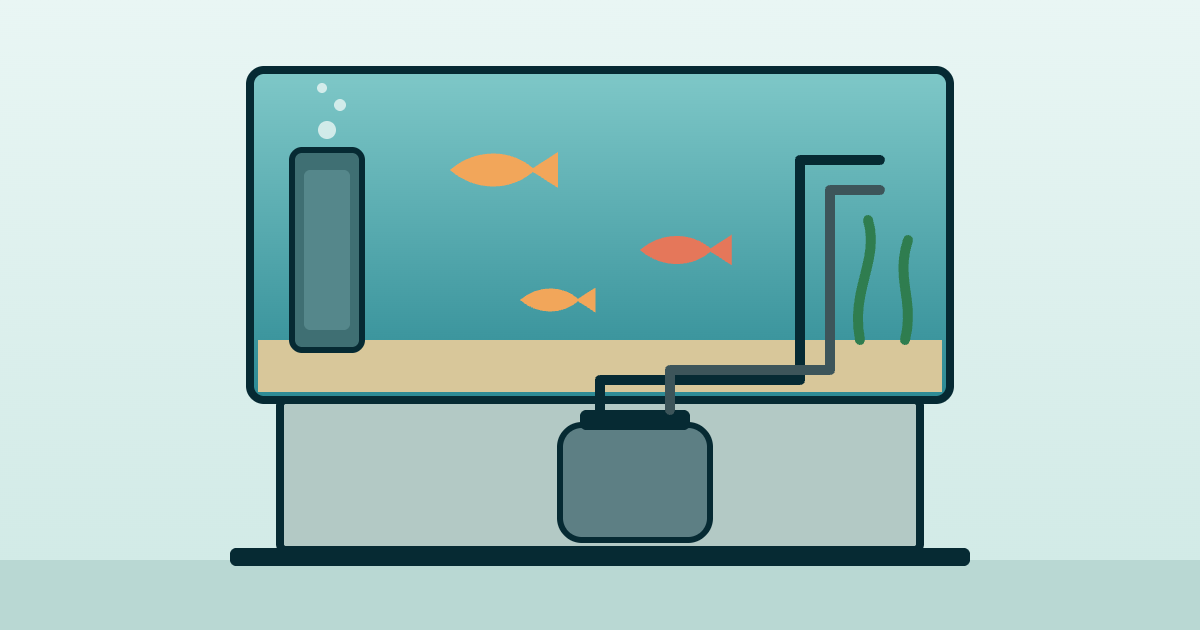
A filter does more than make the water look clean. It traps solid waste and, more importantly, gives the bacteria that remove toxic ammonia and nitrite somewhere to live. This guide explains how the main filter types differ so you can choose one for your tank. We do not yet review individual models, and we will say clearly when we do.
The short answer: for a small, lightly stocked tank, an internal filter or a sponge filter is usually enough. For a bigger or more heavily stocked tank, an external (canister) filter holds much more media and needs cleaning less often. Whatever you choose, pick one rated for at least your tank size, and never rinse the sponge or media under the tap.
What a filter does
Filters work in three ways, and most do the first two:
- Mechanical: sponge or other media traps solid debris such as fish waste and uneaten food. You remove it by cleaning the media. Solids left in the water add to the ammonia load.
- Biological: bacteria turn ammonia into nitrite and then into nitrate. Nitrate is removed by water changes. This is the part that keeps fish alive, and it needs surface area, oxygen-rich water and time to build up. See our guides on how nitrification works and how to cycle a new aquarium.
- Chemical: media such as activated carbon removes some dissolved substances. It wears out and must be replaced, so it is optional for most tanks.
The main filter types
Internal filters
A small pump on a narrow box of sponge, placed inside the tank, often in a rear corner. They are cheap and easy to install and maintain, and they suit small, lightly stocked tanks. The downsides are that they hold little media, take space in the tank and need cleaning more often. They can struggle to keep water in good condition in a heavily stocked tank.
External (canister) filters
These sit in the cabinet under the tank. Water is pumped out through a hose, cleaned and returned. They hold much more media, need cleaning less often, give you room to use several kinds of media and suit demanding fish or higher water-quality goals. They cost more, and you need space and a stable place for them.
Hang-on-back filters
These hang on the back rim of the tank and pull water up through a media cartridge or tray. The shop guides we used describe them as a good fit for small to medium community tanks, easy to reach and maintain, with less media capacity than a canister. They can also be noisy. They are less covered by the university and magazine sources, so treat this as a general description.
Sponge filters
A sponge filter is a sponge that air from a small air pump pulls water through. It gives mechanical and biological filtration, with no heating element and no moving parts inside the tank, and the flow is gentle. That is why they are popular with shrimp, fry and fish that dislike strong currents. They are common aquarist practice rather than something the sources we used for this guide cover in detail. See our budget hack on sponge filters.
Undergravel filters
A slatted plate under the gravel with water drawn through it. They are cheap and give bacteria a large surface, but they are more work to maintain, and they can cause problems in planted tanks or if neglected. We would not choose one for a new tank today.
How big should the filter be?
There is no single standard figure. Practical Fishkeeping’s simple advice is to choose a filter rated for at least your tank size, and ideally a bit larger. Messy fish and heavily stocked tanks need more. Filters are rated in litres per hour (lph), and dividing the rating by your tank volume gives the turnover: how many times the whole tank passes through the filter each hour. The sources we used for this part differ. Charterhouse Aquatics suggests 5 to 10 times for community and planted tanks, while Tankfacts and Tropical Treasures say 4 to 6 times. Tropical Treasures puts messy species such as cichlids, goldfish and plecos at 8 to 10 times, and Charterhouse suggests 3 to 6 times for shrimp. Around 5 to 6 times is where the community-tank figures overlap, so a 100-litre tank would need a filter rated for roughly 500 lph. Keep in mind that:
- Ratings are the maker’s estimate. They depend on how much media is in the filter and how clogged it is.
- Flow matters for the fish. A very slow flow can reduce oxygen, while a strong flow bothers some species. Long-finned fish such as bettas usually prefer gentle water, so check the profile of your fish.
- Biological capacity depends on surface area. More media and more oxygen-rich flow give bacteria more room.
Cleaning without killing the bacteria
- Rinse sponges in tank water, for example water you have just siphoned out during a water change. Tap water contains chlorine, which kills the beneficial bacteria, and the filter may take about a month to recover.
- Clean when the flow slows, not on a rigid schedule. For an internal filter that is often about every two weeks, but it depends on the tank.
- If the sponge clogs very quickly, the filter may be too small for the tank. Consider upgrading.
- Replace carbon when it is used up, because old carbon can release what it absorbed.
- Some fish medicines can harm the filter bacteria. Treat sick fish in a separate tank where you can. See our quarantine guide.
Upgrading or replacing a filter
Do not simply swap an old filter for a new one, because that removes the bacteria your fish depend on. Run both filters side by side for a while, or move media from the old filter into the new one, and test the water for ammonia and nitrite until it settles. A brand-new filter needs to mature, which typically takes several weeks.
Frequently asked questions
Do I need a filter at all?
For most tropical tanks, yes. Some very lightly stocked, heavily planted tanks run with little filtration, but that takes experience. See our Walstad method guide. For a first tank, use a filter.
Should I switch the filter off at night or during a power cut?
Do not switch it off at night. The bacteria need a constant supply of oxygen-rich water. After a power cut, see our power cut guide.
Sources
- Practical Fishkeeping, “Choosing an aquarium filter”: internal, external and undergravel filters, the three filtration types, sizing advice, cleaning in tank water, and upgrading.
- Texas A&M AgriLife Extension, “Principles of Water Recirculation and Filtration in Aquaculture” (FA12): written for fish farms, used here for the principles of mechanical and biological filtration, surface area, oxygen and conditioning a new filter.
- Charterhouse Aquatics: Choosing the right freshwater filter, Tankfacts: Types of aquarium filters and Tropical Treasures: Aquarium filtration guide: hang-on-back filters and the flow-rate figures. These are shop blogs, so their product advice may reflect what they sell. We used them only for general points.
The notes on sponge filters and on flow for particular species are common aquarist practice, not drawn from the university or magazine sources. We do not recommend specific products yet. See all our sources.