
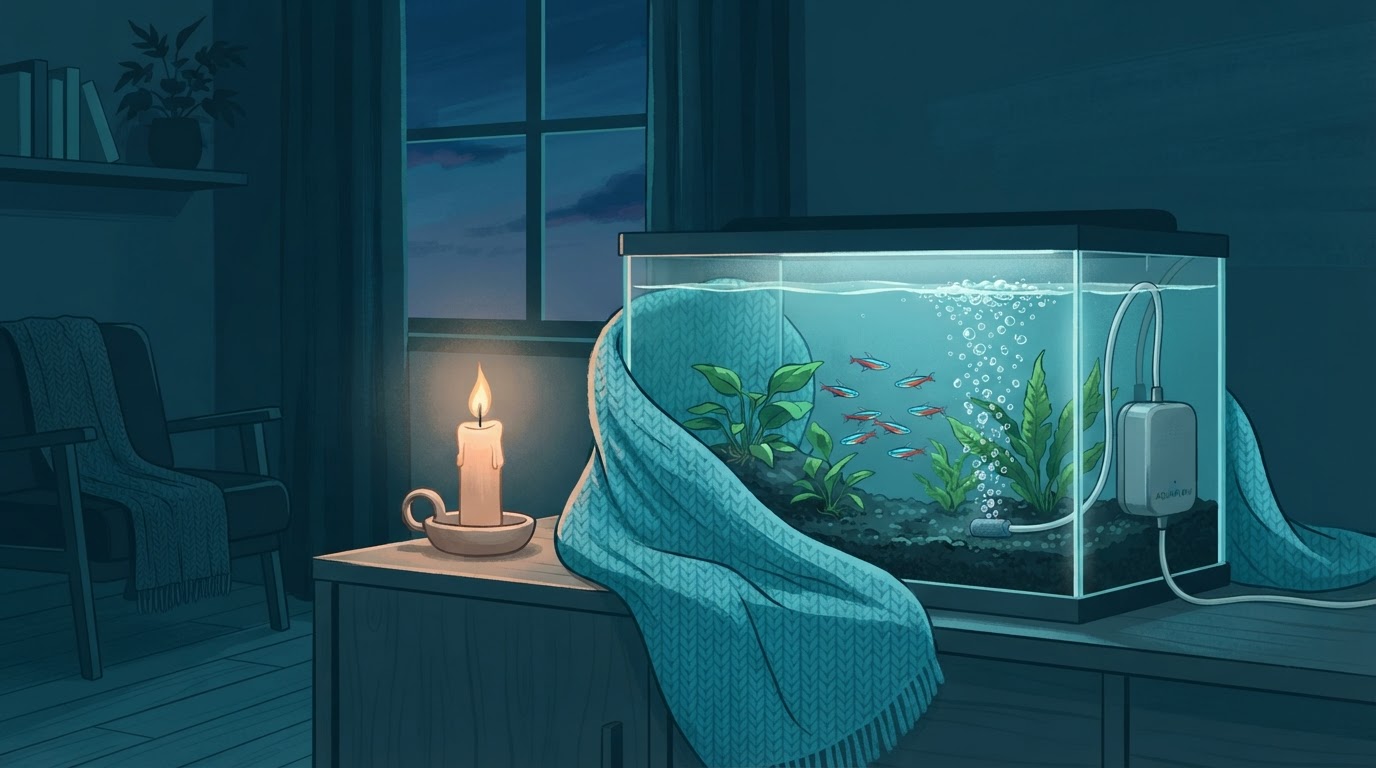
Most power cuts are short and a tank in a heated home holds its temperature for a long time. The bigger risks are oxygen and your filter bacteria, which depend on moving water.
During the outage
- Do not feed. Food adds waste and raises oxygen demand.
- Add air if the cut is long. A battery-powered air pump is the cheapest protection. Start it early rather than late.
- Protect the filter bacteria. Bacteria begin to die once water has stopped flowing through the filter for roughly an hour. You can place the filter media in the tank, above an airstone.
- Keep heat in. Cover the top and sides with towels or a blanket, since most heat escapes from the top. Tanks in sheds or garages are more at risk than tanks indoors.
When power returns
- Check that the filter, heater and pumps all restart. A dirty impeller can run fine normally but fail to restart.
- Feed very lightly for a few days, and not at all if tests show ammonia or nitrite.
- Test the water for several days and do small, regular water changes if ammonia or nitrite appear. See our nitrification guide for why these matter.
Prepare now
Keep a battery air pump and spare batteries, clean the filter impeller when you do your monthly maintenance, and keep a water conditioner that removes ammonia at home. In a heatwave the risks differ; see cooling in a heatwave.
Sources
- Maidenhead Aquatics (UK retailer), “Dealing with a power cut on your aquarium”, fishkeeper.co.uk.
The source gives no exact survival time, so neither do we. A retailer is also a commercial source. Full list on our sources page.