
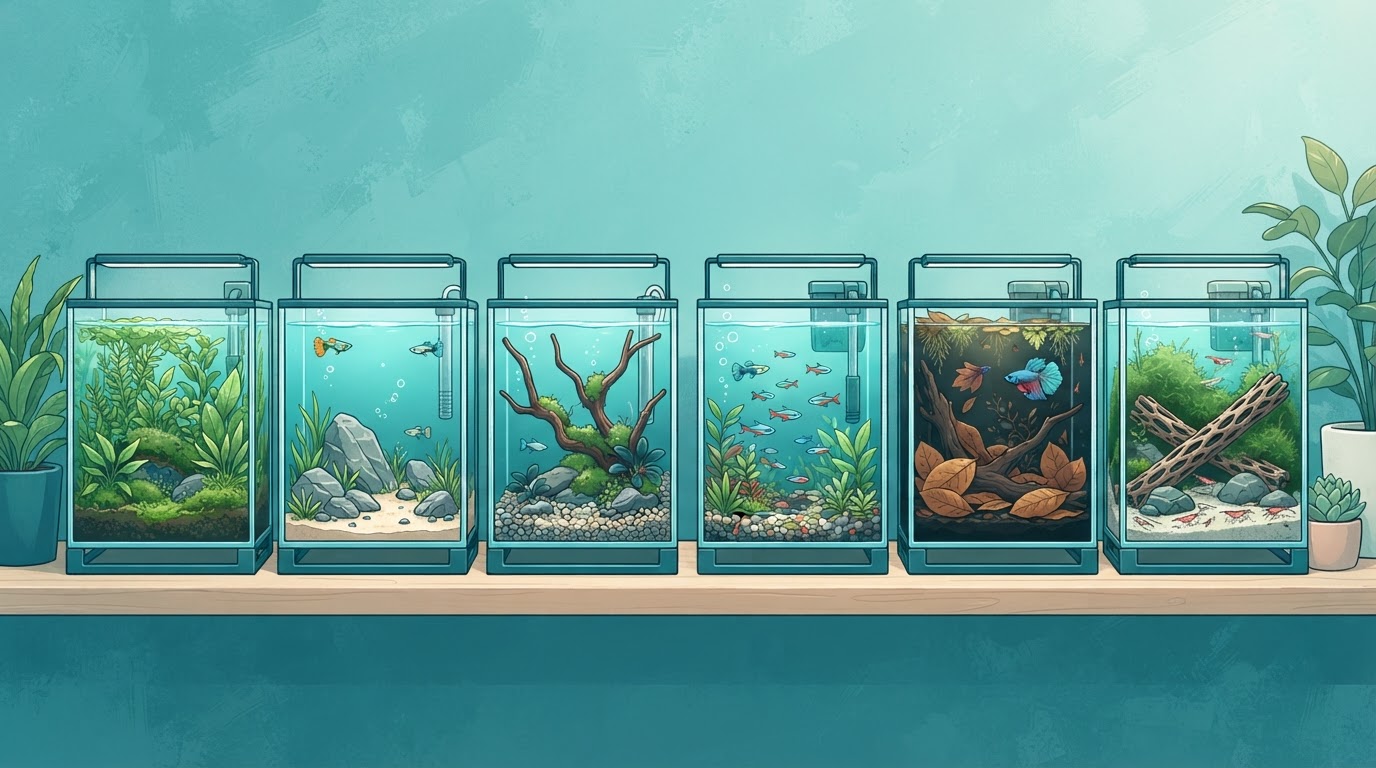
There is no single right way to keep an aquarium. Styles differ in what you put at the centre (fish, plants, a landscape or a real habitat) and in how much technology and time they need. This guide maps the main ones, based on hobby sources, and points you to a detailed article for each. Not sure where to start? Try the style quiz.
Two ways to describe a tank
Design style is how the tank looks and what it is for: a plain community tank, a formal Dutch plant garden, a Nature Aquarium landscape, a biotope copy of one habitat, or a species-only tank. Technology level is how it is run: low-tech (basic light, no injected CO2) or high-tech (strong light, pressurised CO2, nutrient-rich substrate). Most designs can be run at either level, though some carpeting plants and dense Dutch-style planting do much better with CO2.
The main styles
Community tank
Several peaceful species share one tank, usually with hardy plants. It is the default for beginners and needs no special rules beyond choosing compatible fish: stocking checker, compatibility chart.
Species-only tank
One fish or shrimp species, with the water, flow and decoration tailored to it. See the shrimp-only guide.
Dutch style
A formal, garden-like arrangement of many plants, grouped by colour and texture and trimmed into rows. It began in the Netherlands in the 1930s. Read the Dutch style guide.
Nature Aquarium, iwagumi, ryuboku and diorama
Popularised by Takashi Amano in Japan: a miniature natural landscape built from rock, wood and a few plant species. Read the Nature Aquarium guide.
Jungle style
A looser mix of Dutch and nature styles: untrimmed, bold, coarse-leaved plants, little visible hardscape and dense cover, with floating and tall plants shading the tank.
Low-tech and Walstad
Plants kept alive with modest light, no injected CO2 and often a soil substrate. Cheaper and more forgiving. Read the low-tech guide.
Biotope
A tank that recreates one real habitat, including its fish, plants, substrate and water chemistry, such as a blackwater Amazon stream or an African Rift Lake. Read the biotope guide.
Paludarium and riparium
Set-ups that mix water and land, or grow plants along a bank. The sources we read only mention these briefly, so we do not cover them yet.
Comparing them
| Style | Centre of attention | Time and trimming | Technology |
|---|---|---|---|
| Community | Fish | Low | Basic |
| Species-only / shrimp | One species | Low to medium; cycling matters | Basic, stable water |
| Dutch | Plants in rows | High: frequent trimming | Strong light, usually CO2 |
| Nature Aquarium | Landscape | Medium to high | CO2 helpful for many carpets |
| Low-tech / Walstad | Plants, easy species | Low | Modest light, no CO2 |
| Biotope | Real habitat | Medium; research heavy | Depends on habitat; tap water must suit |
This table is our own summary of the sources below, not measured data.
How to choose
- Tight budget or little time: community or low-tech. See also Budget Hacks and the running cost calculator.
- You love plants and have time: Nature Aquarium or Dutch.
- You love learning about places: biotope. Check your tap water first with the hardness guide.
- Little space: a shrimp-only tank, or read small tanks.
Sources
- George Farmer, “The Aquascaper Series: Styles”, AMAZONAS Magazine, 2015.
- “Aquascaping”, Wikipedia (history, Dutch, Nature, iwagumi, ryuboku, diorama, jungle and biotope descriptions).
- Aquifarm, “Fish Tank Styles”, aquifarm.com (community, species-only, low- and high-tech overview).
Hobby and retail sources; no peer-reviewed work. Each style article lists its own sources. Full list on our sources page.