
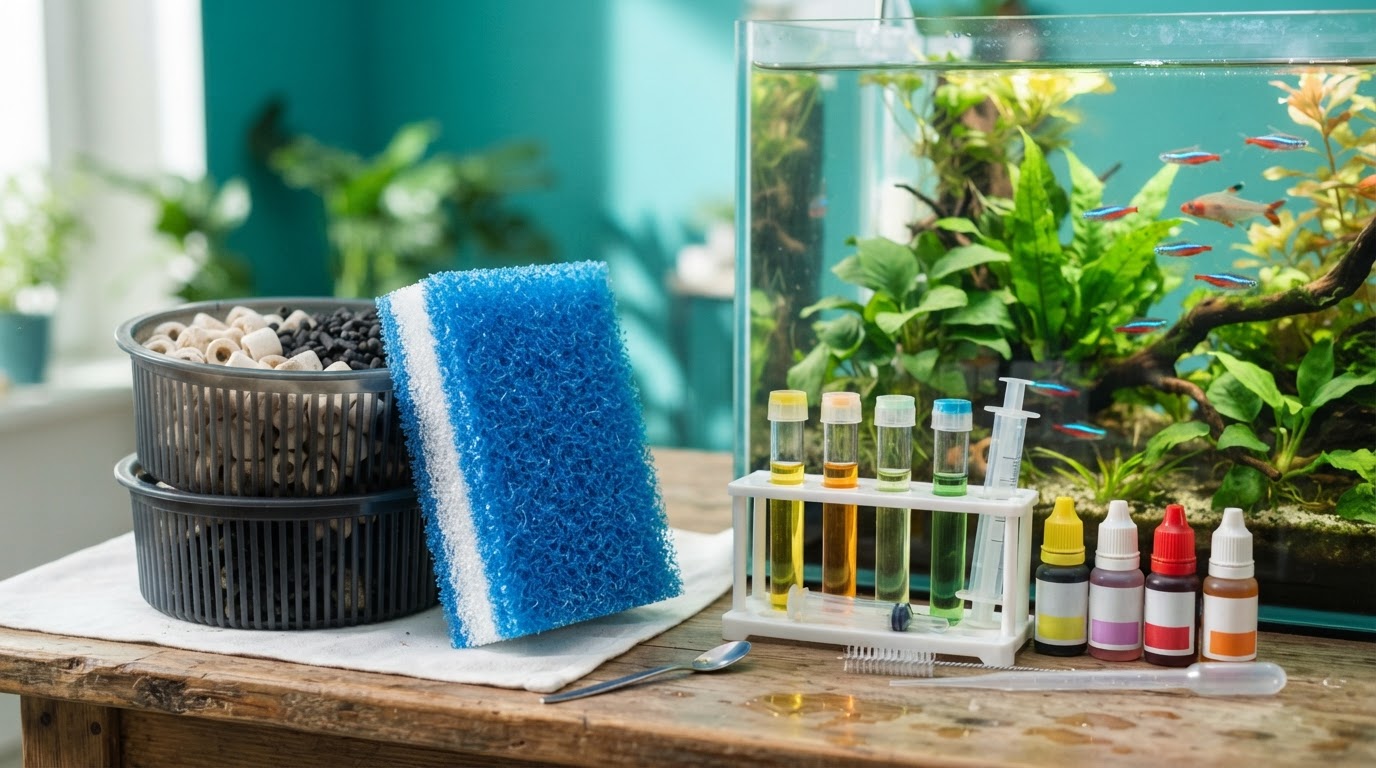
A new aquarium is not ready for fish when the water is clear and the heater is on. It needs a working biological filter: bacteria that convert toxic ammonia into nitrite and then into much less harmful nitrate. Building that population is called cycling, and doing it before you buy fish is the kindest way to start.
The short answer: add an ammonia source to the running tank, test regularly, and add fish only when ammonia and nitrite both read zero within about 24 hours of feeding the tank. This usually takes several weeks.
What is happening in the tank
Fish release ammonia through their gills and waste, and it is toxic to them. University of Florida extension material describes nitrification as a two-step process: one group of bacteria converts ammonia to nitrite, and another converts nitrite to nitrate. These bacteria grow slowly on surfaces such as filter media, so a new tank has too few of them. The science is explained further in nitrification explained.
What you need
- A set-up tank with filter, heater and dechlorinated water (see the setup guide).
- A liquid test kit for ammonia, nitrite and nitrate. Test strips are less accurate.
- An ammonia source: pure household ammonia with no additives, or a few pinches of fish food added daily.
Steps
- Run the filter and heater continuously at your target temperature.
- Add your ammonia source, aiming for a modest reading of around 2 mg/L (ppm) on the test kit.
- Test every few days. First ammonia should fall while nitrite rises, then nitrite should fall while nitrate rises.
- When the tank clears the dose within 24 hours, with zero ammonia and zero nitrite, do a large water change to lower nitrate.
- Add fish gradually, a few at a time, and keep testing for the first weeks.
Common mistakes
- Adding all the fish at once. The bacteria population only supports the waste load it has grown for.
- Cleaning the filter media in tap water. Chlorine can harm the bacteria. Rinse it in old tank water instead.
- Judging by clear water. Ammonia and nitrite are invisible; see the clear-water myth.
Frequently asked questions
How long does cycling take?
It varies with temperature and the bacteria available. Plan for several weeks and trust your test kit, not the calendar.
Do I need to test pH as well?
It is useful. See the water parameters guide.
Sources
- University of Florida: Process of Nitrification in Aquaria: the two-step conversion of ammonia to nitrite to nitrate.
- UF/IFAS: Ammonia in Aquatic Systems: ammonia as a toxic waste product of fish.
The fishless procedure, target dose and the “24 hours” rule are common aquarist practice, not figures from these documents. See all our sources.
Leave a Reply