
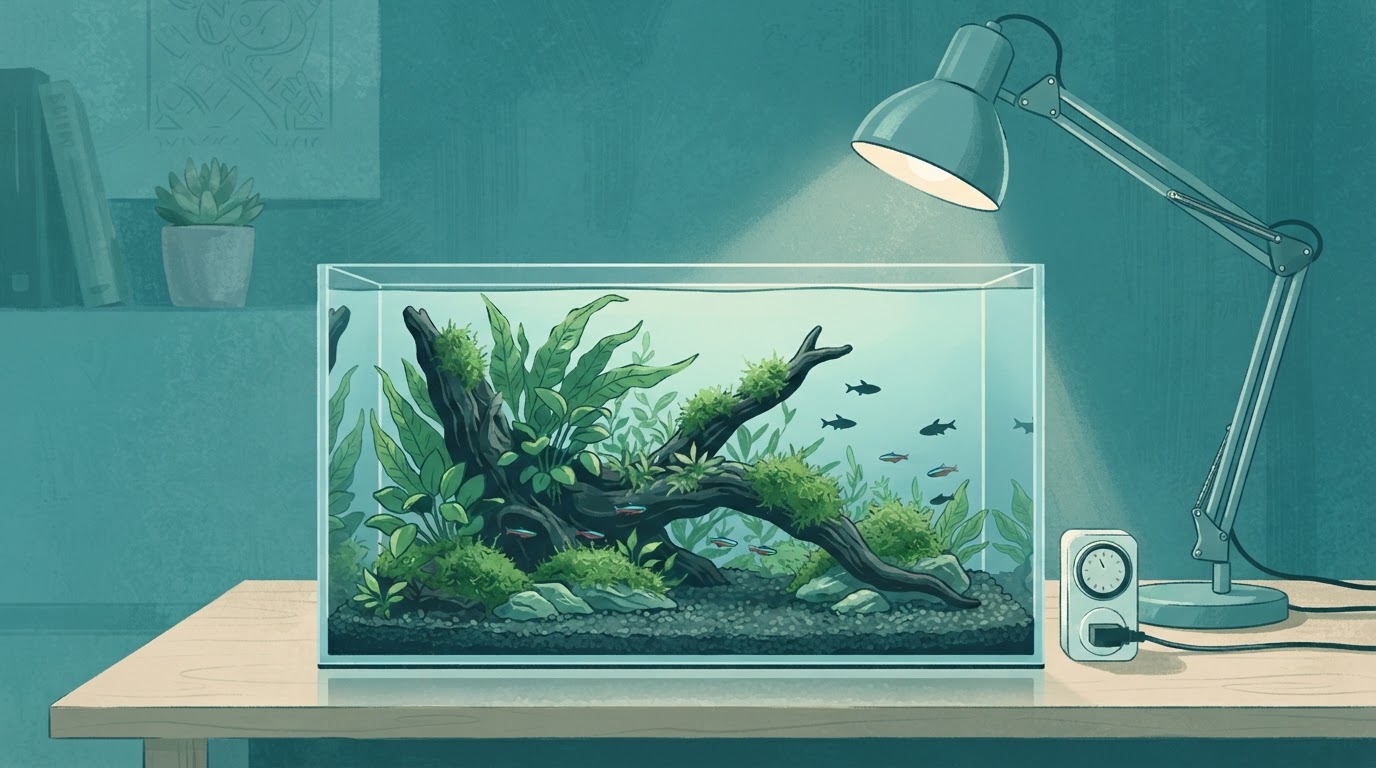
The low-tech approach fits AquaHorizon’s mission best: attractive plants without costly equipment or constant upkeep. Part of our styles guide.
What low-tech means
A high-tech tank typically uses strong lighting, injected CO2 and nutrient-rich water and substrate. A low-tech tank uses modest light and no injected CO2. Plants grow more slowly, so there is less pruning and less algae, but the results are less dramatic and CO2 levels vary from tank to tank, which makes outcomes less predictable.
Plants that suit it
- Low-light and easy: Cryptocoryne, Anubias, Java fern and mosses.
- Slow-growing rosettes are the easiest to maintain: Cryptocoryne (the slowest), Vallisneria, Aponogeton and Echinodorus.
- Stem and carpeting plants need frequent trimming and are generally avoided.
Light and substrate
Lower light slows growth, and photoperiods down to about six hours save electricity. A plug-in timer keeps the schedule steady; see running costs. A nutrient-rich substrate can reduce the need for liquid fertiliser, because rooted plants take much of their food through their roots.
The Walstad method
The Walstad method is a low-tech approach linked to Diana Walstad’s book Ecology of the Planted Aquarium. It uses a soil substrate and dense plant growth to need fewer inputs. It does not mean skipping water changes, testing or oxygen. Injected CO2 is not required, and a densely planted tank should not be assumed to run without a filter or aeration. A heater may still be needed. Freshly submerged soil can release ammonia and use up oxygen, so it does not prevent new-tank problems. Run the tank without fish first, watch ammonia, nitrite and pH, and stock conservatively. Our cycling guide still applies.
Limits and cautions
- Small tanks under about 40 litres are less stable, so they need careful stocking and regular care. Larger tanks are more forgiving. See small tanks.
- Digging fish such as goldfish are not suited, however deep the substrate.
- Liquid carbon products are sometimes used instead of CO2, but sources disagree: one calls them a safer, cheaper substitute, another says they do not raise CO2 levels, and the main ingredient is toxic at high doses. We do not recommend them.
- High light without CO2 invites algae.
Related: floodlight as aquarium light (check the heat and safety warnings), and the style quiz.
Sources
- George Farmer, “The low tech planted aquarium”, Practical Fishkeeping, 2009, web version 2016, updated 2019 (plants, light, substrate, nano tanks, liquid carbon).
- Build Your Aquarium editorial staff, “The Walstad Method for Planted Tanks”, buildyouraquarium.com, 2021, updated 2026.
- The 2Hr Aquarist, “Do you need CO2 for a planted aquarium?”, 2hraquarist.com. A retailer.
These are hobby and retail sources, not studies. Full list on our sources page.