
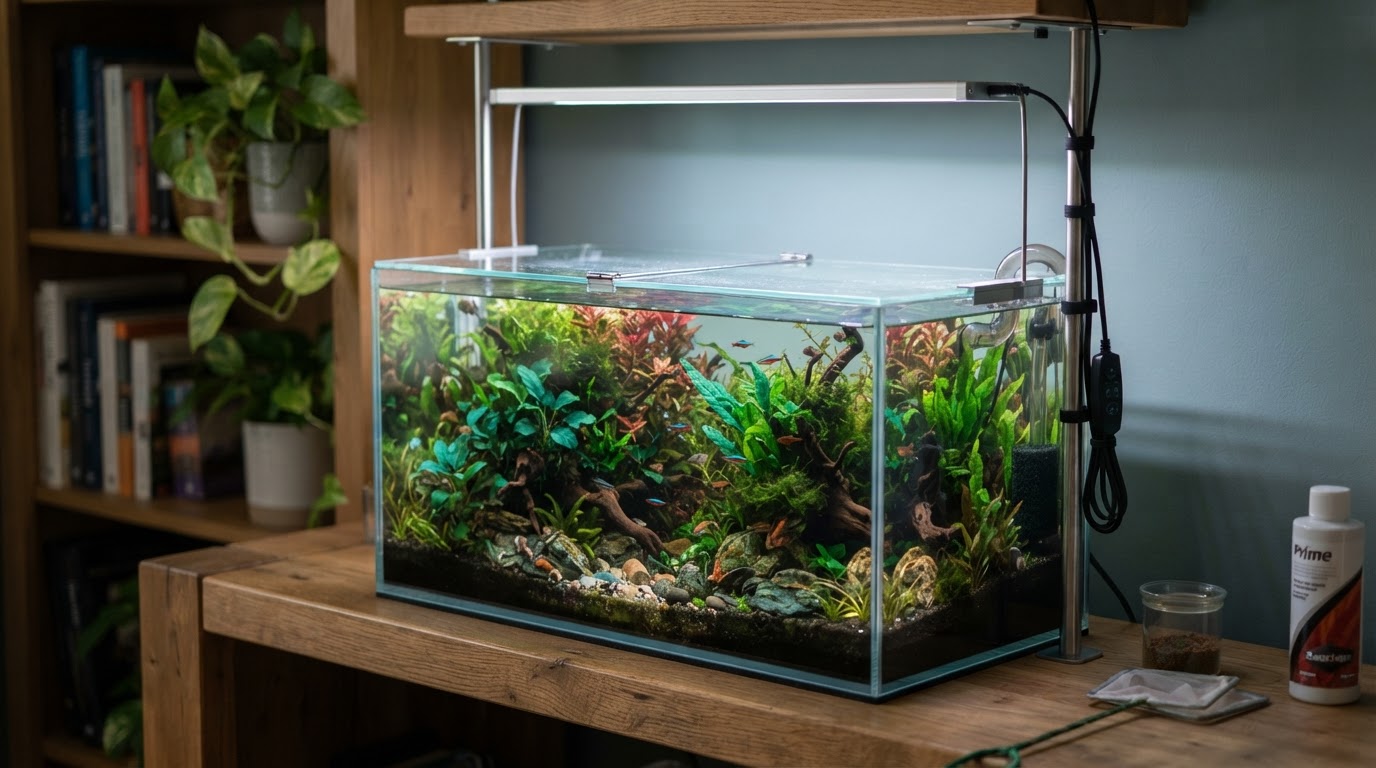
Risk label: Take care. This hack involves mains electricity near water. We do not recommend any DIY wiring. Read the safety box below before you try it. How we rate hacks
Aquarium lights can cost more than the tank. That is why people look at cheap LED floodlights from the hardware store. It can work, but a floodlight is built for a garden wall, not for a humid glass box full of water, so three things need checking: how bright it is, how it gets hot and how it is installed.
The short answer: an LED floodlight can light a tank, but only if it is not too bright, is a finished product used as intended, and is mounted away from splashes and condensation. If you are unsure about any of that, buy a cheap purpose-made aquarium LED instead.
What plants and fish actually need
Watts and “6500 K” labels tell you little. A planted-tank guide we read explains that colour temperature only describes the look of the light, not how well plants grow, and recommends judging light by intensity at the substrate (PAR). For low-tech tanks without CO2 it suggests roughly 20 to 60 µmol, and warns that more light in such a tank mostly feeds algae. Photoperiod guidance from the same source is 5 to 6 hours for new tanks and 7 to 8 hours for stable low-tech tanks.
That is the catch with floodlights: many are far brighter than a low-tech tank needs, most cannot be dimmed and you cannot measure PAR without a meter. Too much light is the most common reason for an algae outbreak.
Safety box
- Use only a complete, CE-marked fitting with its original plug. Never modify the wiring.
- Choose LED, not halogen: halogen lamps get very hot.
- Mount it on a stand or bracket above the tank, never resting on a plastic lid, and keep the tank lidded so splashes and condensation do not reach it.
- Let the cable hang down in a loop below the socket so water cannot run along it into the plug.
- Keep plugs and sockets higher than the water, and use an RCD (residual-current device) on the circuit.
- Put the light on a timer so it matches a sensible photoperiod.
These precautions are general electrical-safety practice, not advice specific to your home. If you are unsure, ask a qualified electrician.
Better budget alternatives
- A basic purpose-made aquarium LED, with a timer plug, often costs little more than a floodlight.
- Choose low-light plants such as Anubias and Java fern, which do well at low intensities.
- Start with the shortest photoperiod and add time only if plants clearly need it.
Frequently asked questions
Does it need to be a special aquarium colour?
Not for plants, according to the guide we read, but a light with weak red output makes fish and plants look dull. Judge by how it looks.
Sources
- 2Hr Aquarist: Planted Tank Lighting 101 (a retailer’s blog): colour temperature, PAR bands, spectrum, photoperiod and algae.
The electrical safety points and the comments about floodlight brightness and dimming are our general practice-based advice, not from a published standard, and we have not tested any specific floodlight. See all our sources.
Leave a Reply