
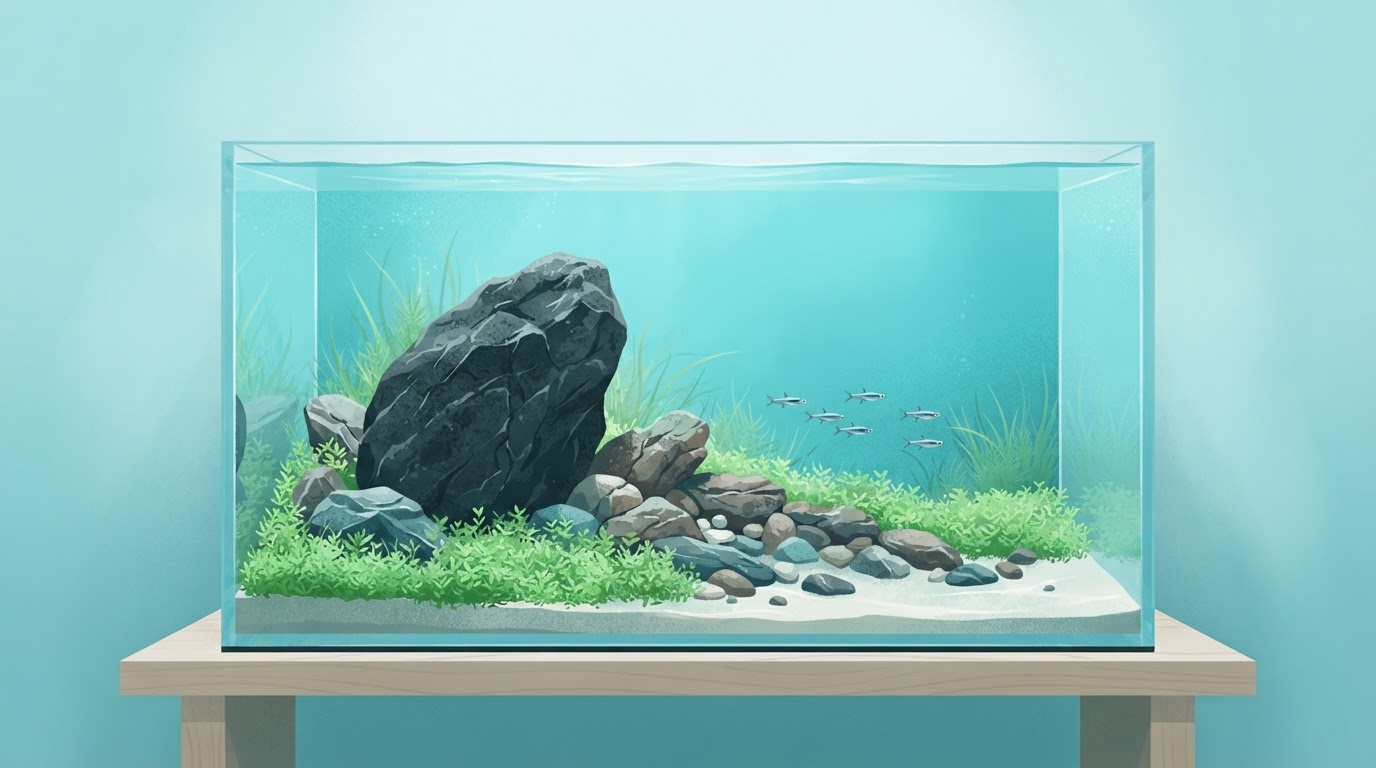
The Nature Aquarium style, popularised by Takashi Amano in Japan in the 1990s, is arguably the most popular style of freshwater planted aquascaping today. Part of our styles guide.
The idea
Recreate a natural landscape in miniature, such as a mountain range, forest floor or riverbank, from rock, wood and plants. It draws on Japanese garden thinking and the idea of wabi-sabi. Compared with Dutch style it has few rigid rules, as long as the result feels natural.
Three sub-styles
- Iwagumi: stones lead. A large main stone is placed off-centre with smaller companion stones grouped near it.
- Ryuboku: wood is the main hardscape, often breaking the water surface, usually one type of wood with moss.
- Diorama: a complex built scene of real or imagined scenery with small plants to keep scale. It can take months to build.
Design principles
- One dominant focal point, placed off-centre, supported by a few secondary pieces.
- Odd numbers and asymmetry: groups of three or five rather than pairs.
- One type of rock and a consistent character of wood, partly buried so it looks grown in.
- Depth through foreground, middle ground and background, with open space and shaded recesses.
Plants, light and CO2
One retailer guide suggests that roughly 70% of the plant mass should be non-stem species such as Java fern, Anubias, Bucephalandra and Cryptocoryne, with stem plants as accents. The same guide recommends moderate light and photoperiods of six to eight hours, and says CO2 gives more reliable growth and that many carpeting plants depend on it. This guide is from a company that sells aquascaping equipment, so treat the CO2 emphasis with care. A low-tech version is possible with hardy plants.
Common beginner mistakes
- Too many fast-growing stem plants that need constant pruning.
- Running the light at factory brightness, which feeds algae. Reduce intensity before shortening the photoperiod.
- Centring the focal point or using even numbers.
- Mixing rock types from different sources.
- Choosing digging or large fish that uproot plants and shift the hardscape.
Budget angle: see preparing driftwood. Not sure it is for you? Take the style quiz.
Sources
- George Farmer, “The Aquascaper Series: Styles”, AMAZONAS Magazine, 2015.
- “Aquascaping”, Wikipedia (sub-styles).
- The 2Hr Aquarist, “What is a nature style aquascape?”, 2hraquarist.com (design principles, plants, mistakes). A retailer.
The retailer’s plant ratio and light figures are one source’s recommendation, not a standard. Full list on our sources page.
Leave a Reply