
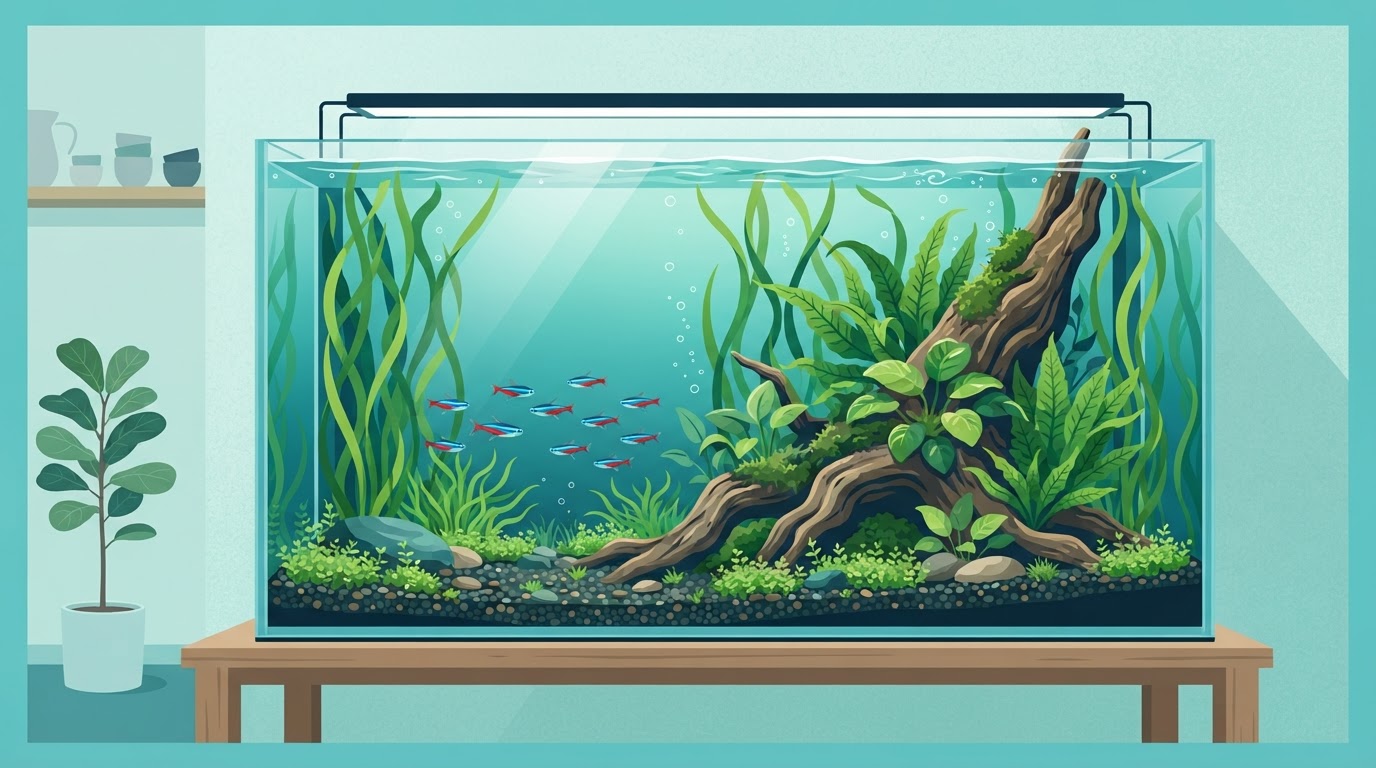
Live plants help keep a tank stable and give fish cover. Most beginner problems come from planting a species the wrong way, not from the plant itself. The easiest way to choose is by how a plant is planted.
Plants you attach, not plant
Anubias, java fern and java moss. Aquifarm describes anubias and java fern as hardy plants that cope with low light, and Aquarium Co-Op also lists java fern among its easy plants. They are rhizome plants: tie or glue the rhizome (the thick stem) to wood or rock with thread or gel glue. Do not bury it, because a buried rhizome can rot. They feed mainly from the water, so a liquid fertiliser suits them. Java moss can be tied to decor or left floating, and trimmed when it spreads.
Root feeders you plant in the substrate
Cryptocoryne (such as C. wendtii), Amazon sword and vallisneria. These take nutrients through their roots. Bury the roots but keep the crown, where the leaves come out, above the substrate. Root tabs (slow-release fertiliser capsules) help, especially in inert substrate such as plain sand or gravel. Aquarium Co-Op suggests crypts need almost no special light and no CO2.
- Melting is normal. Crypts and swords often lose leaves after being added to a tank. Aquarium Co-Op says to leave them planted, and they usually regrow. Crypts can take around three months to settle.
- Vallisneria grows tall and spreads by runners, so it suits the back of the tank. Leave room for it.
- Amazon sword is a large plant and a heavy root feeder. It does best with deeper substrate and root tabs.
Fast growers that help new tanks
Hornwort and bacopa. Aquifarm notes that hornwort grows quickly and absorbs nutrients well, which helps in a new tank. It floats or can be weighted and does not root. Bacopa is a stem plant: plant each stem separately, remove any rubber band at the base, and trim the tops over time. In strong light and with iron it can turn coppery at the tips.
Light, CO2 and fertiliser
- Aquifarm says ordinary LED lights are generally enough for these plants, run about 8 to 10 hours a day on a timer, away from direct sunlight.
- CO2 injection is usually unnecessary at this level. See our guide to low-tech planted tanks.
- A liquid fertiliser about once a week suits most low-tech tanks, following the product label. Root tabs are replaced about every three to six months.
- Do not cover the whole surface with floating plants. Aquarium Co-Op warns this can lower oxygen for fish and starve the plants below of light.
Algae appears when light or nutrients exceed what the plants use. A shorter light period, more plants and regular maintenance help. Our algae prevention guide goes deeper.
Mistakes to avoid
- Burying a rhizome, a sword’s crown or the leaf bases of grass-like plants.
- Throwing away a plant that is melting after planting.
- Choosing carpeting plants first. Aquarium Co-Op says these need strong light, CO2, liquid fertiliser and root tabs, so they are not beginner plants.
- Planting before you know your light and substrate. Our styles guide shows how plant choice fits each style.
Which species suit which fish and water hardness is not covered by these sources, so check each plant’s needs against your tap water before buying.
Sources
- Aquarium Co-Op: Top 10 Easy Aquarium Plants for Beginners (retailer guide)
- Aquarium Co-Op: Quick Guide, How to Plant Live Aquarium Plants (retailer guide)
- Aquifarm: Beginner Fish Tank Plants (retailer guide)
These are hobby and retail sources, not scientific studies. The advice to check plants against your tap water is our own judgement. See all sources and how we use them.
Leave a Reply