
Ask ten aquarium keepers how often to change the water and you will get ten confident answers. The truth is that there is no single number that suits every tank, but there is a sensible starting point and a simple way to fine-tune it for your own setup. This guide gives you both.
The short answer: for most tropical community tanks, changing roughly 20 to 30 percent of the water once a week works well. Lightly stocked, heavily planted tanks can often manage with less, and heavily stocked tanks may need more.
Why water changes matter
Your filter does not remove most of what accumulates in the water; it converts it. Beneficial bacteria turn toxic ammonia and nitrite into nitrate, but nitrate itself stays in the tank until plants absorb it or you remove it with a water change. Water changes also replenish minerals, dilute dissolved organic compounds that build up over time and help keep conditions steady. If you want the background, our water parameters guide explains each of these measurements.
How much and how often: a starting guide
| Type of tank | Suggested routine |
|---|---|
| Typical community tank, moderate stocking | 20 to 30 percent weekly |
| Heavily planted, lightly stocked | 10 to 20 percent weekly, or a larger change every two weeks |
| Heavily stocked or large messy fish | 30 to 50 percent weekly, or smaller changes more often |
| New tank, first weeks with fish | Based on test results; change water whenever ammonia or nitrite appears |
These are starting points, not rules. Consistency matters more than the exact figure: a steady weekly routine beats an occasional huge change.
Work out your own routine with a nitrate test
The most reliable method is to let your test kit decide. Measure the nitrate in your tap water, then in your tank just before a water change. Your goal is to keep tank nitrate below about 40 mg/L, ideally under 20.
A rough rule of thumb: the nitrate left after a change is the old level multiplied by the fraction of water you keep, plus a little from the new water. For example, if your tank reads 40 mg/L and your tap water has none, a 25 percent change takes it to roughly 30 mg/L. A 50 percent change would take it to around 20. Enter your own numbers into our water change calculator to get the exact percentage and litres.
- If nitrate climbs above your target between changes, change more water or change it more often.
- If it stays comfortably low week after week, you may be able to ease off, though many keepers still prefer a regular routine for the other benefits.
- If your tap water already contains a lot of nitrate, water changes will lower it less effectively, so you may need to look at stocking, feeding and plants as well.
How to change aquarium water safely
You will need a bucket used only for the aquarium, a siphon or gravel vacuum, a thermometer and water conditioner.
- Prepare the tank. Switch off or unplug the heater before the water level drops below it, since a heater exposed to air while still hot can be damaged. Many keepers also switch off the filter for the duration.
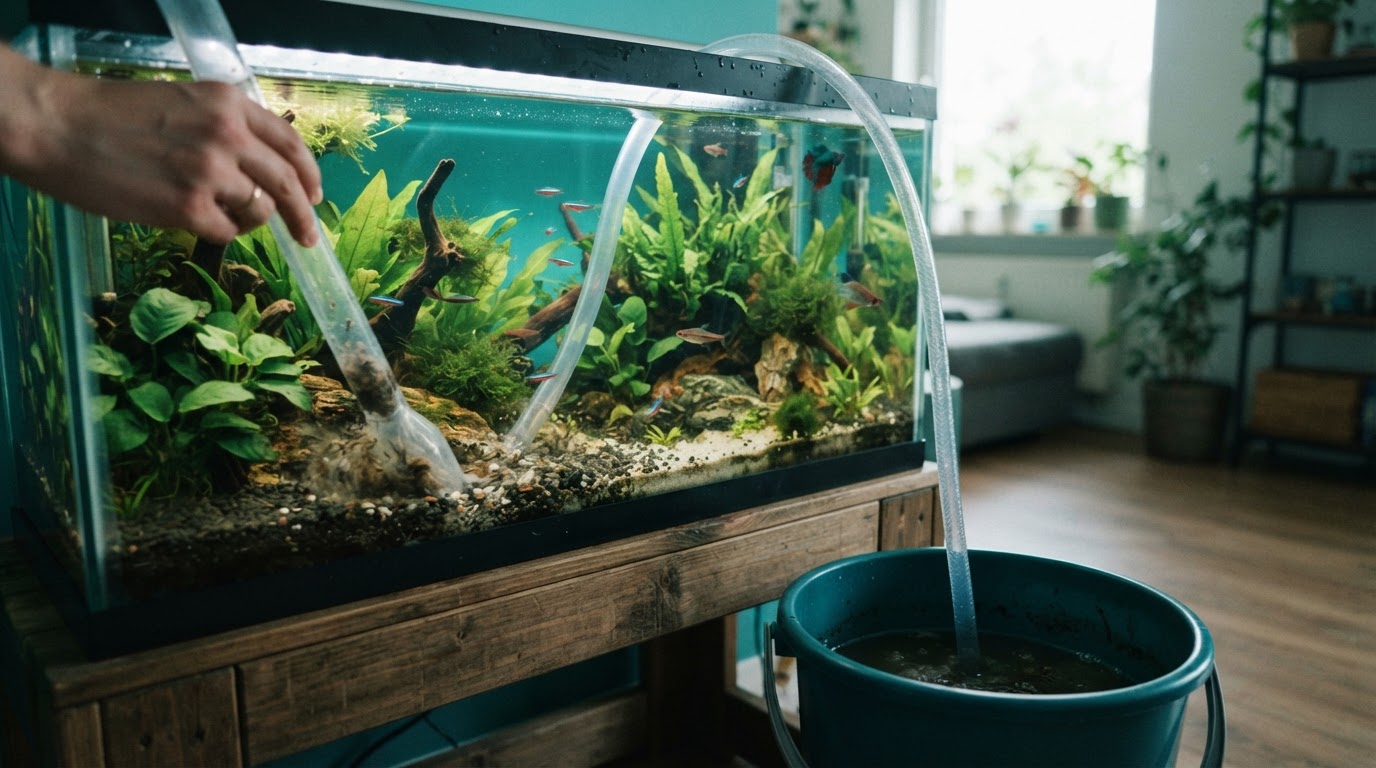
- Siphon out the old water. Use the siphon to draw water out of the tank, passing it over the substrate to lift loose waste. In a planted tank, avoid deep-vacuuming where roots are established.
- Prepare the new water. Fill a bucket with tap water, aiming to match the tank temperature to within a degree or two. Add water conditioner at the dose for the volume of new water, or follow the label if it is dosed for the whole tank.
- Refill gently. Pour or siphon the water in slowly, onto a plate, your hand or a rock, so it does not blast the substrate or stress the fish.
- Restart the equipment. Plug the heater and filter back in once the water covers them, and check that the filter is running properly.
Mistakes to avoid
- Forgetting the conditioner. Chlorine and chloramine in tap water can harm fish and the bacteria in your filter.
- Large temperature differences. Cold water poured into a warm tank can shock fish.
- Changing 100 percent of the water. It is rarely necessary and can cause sharp swings in temperature and chemistry.
- Rinsing filter media under the tap at the same time. Doing both at once removes bacteria and can upset the balance. Rinse the media gently in a bucket of old tank water instead.
- Big changes in water chemistry. If your tap water is very different from your tank, for example much harder, change smaller amounts more often.
Frequently asked questions
Can I skip water changes if the water looks clear?
Clear water is not necessarily healthy water. Nitrate and dissolved waste are invisible, so test instead of judging by eye.
Does a water change disturb the nitrogen cycle?
Not when done properly. Most of the beneficial bacteria live on the filter media and surfaces, not in the water column, so a normal change leaves them in place. Problems arise when untreated tap water or aggressive cleaning kills them.
What should I do before going on holiday?
For a week or two away, a mature, reasonably stocked tank usually copes if you do a normal water change shortly before leaving, feed sparingly, and avoid big last-minute changes to equipment. For longer trips, ask someone reliable to check the tank rather than relying on food blocks.
What if I have an ammonia or nitrite spike?
Do a large water change straight away, add conditioner, feed lightly and retest after a few hours. Then work out what caused it. Our setup guide explains how the nitrogen cycle works.
Where to go next
Regular water changes are also your best defence against nuisance algae. Read our guide to preventing algae in a freshwater aquarium next.
Sources
- The Process of Nitrification in Aquaria, University of Florida teaching module: nitrate is removed by water changes or plant uptake, and regular partial changes of around 25 percent offset the pH drop from nitrification.
- Francis-Floyd et al., Ammonia in Aquatic Systems (FA16), University of Florida IFAS Extension: ammonia toxicity and why large water changes help in an emergency.
The weekly percentages in this guide are common aquarist practice rather than figures from these sources. Use the water change calculator and your own test results to fine-tune them.
Leave a Reply