
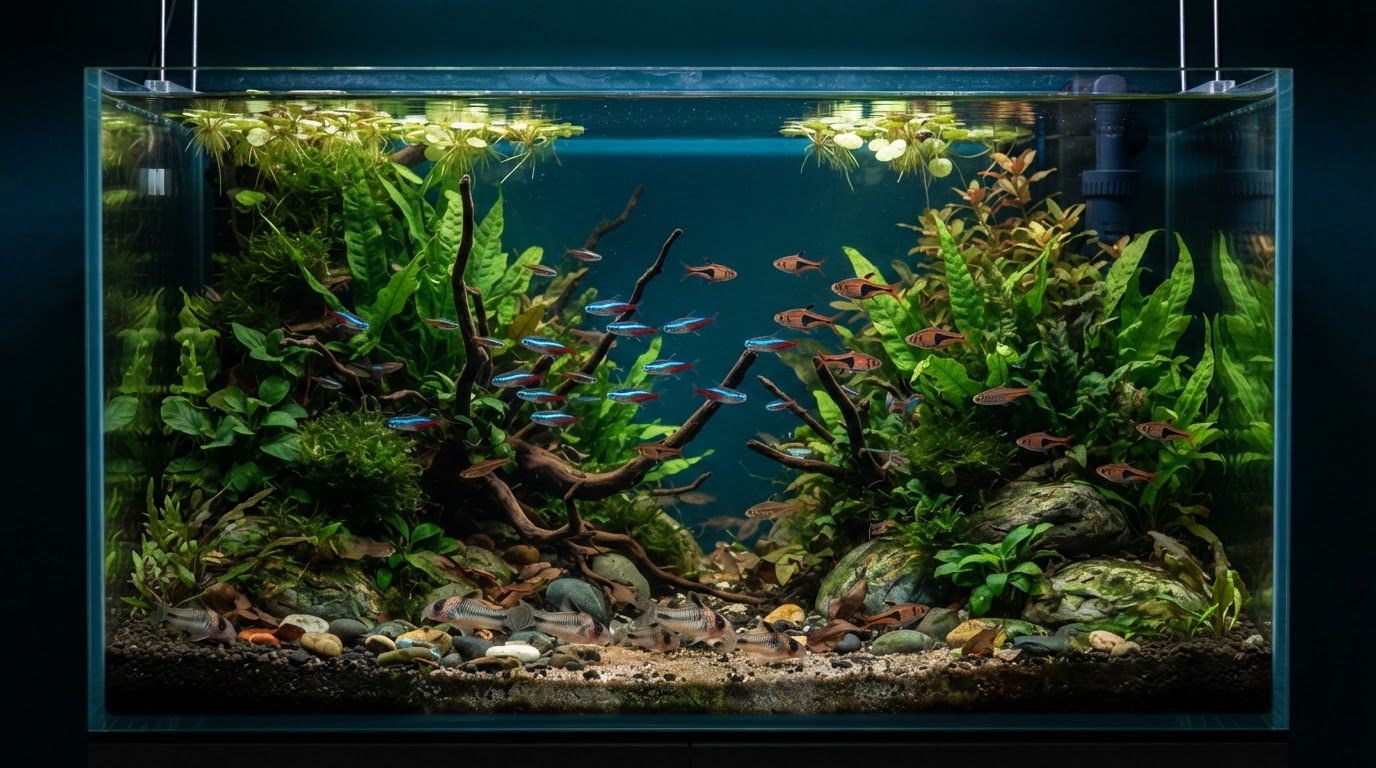
A 60-litre tank, roughly 60 × 30 × 30 cm, is the most popular size for a first aquarium, and also the one most often overstocked. It can hold a lively, colourful community, but only if you choose small, peaceful fish and keep them in proper groups. Below are two realistic stocking plans, one for soft to medium tap water and one for hard water, plus the fish that look cute in the shop but do not belong in a tank this size.
The short version: keep one species of small schooling fish in a group of eight or more, add a small group of bottom-dwellers, and stop there. Add the fish gradually, only after the tank has fully cycled.
Before you choose: match the fish to your water
Tap water in Europe varies from very soft to very hard, and the right plan depends on yours. Look up your hardness first, using our guide to tap water hardness in Europe, then choose the plan below that fits.
Plan A: peaceful community for soft to medium water
Suits tap water up to about 12 °dH, the upper end of the range FishBase lists for harlequin rasboras. Keep the temperature around 24 to 25 °C.
| Fish | Number | Adult size | Notes |
|---|---|---|---|
| Harlequin rasbora | 8 to 10 | About 4 to 5 cm | Hardy, peaceful schooling fish. See the harlequin rasbora profile. |
| Pygmy corydoras | 6 or more | About 2.5 to 3 cm | Tiny, active catfish that swim in the middle of the tank as well as along the bottom. Need a group. |
| Honey gourami (optional) | 1 | About 5 cm | Gentle and shy. Add last, and give it floating plants for cover. |
Ember tetras, which grow to about 2 cm, are an alternative to the rasboras if you prefer a smaller shoal. Use at least ten.
Plan B: livebearer community for hard water
Suits harder tap water, roughly 12 °dH and above. Keep the temperature around 24 to 25 °C.
| Fish | Number | Adult size | Notes |
|---|---|---|---|
| Guppies (males only) | 6 | About 3 to 4 cm | Colourful and active. An all-male group avoids a population explosion. |
| Peppered corydoras | 6 | About 6 cm | Tolerates a wide range of water and slightly cooler temperatures. Use sand or smooth fine gravel. |
If you keep mixed sexes of guppies, platies or mollies, expect breeding. Females give birth every month or so, and a small tank fills up fast, so decide beforehand what you will do with the offspring.
How to build up the stocking
- Finish a fishless cycle first.
- Add the bottom-dwellers, or half of the schooling fish, first.
- Wait one to two weeks, testing ammonia and nitrite, then add the rest.
- Leave any extra species until the tank has run smoothly for a couple of months.
Fish to avoid in a 60-litre tank
- Common pleco: grows to 30 cm or more and produces a lot of waste.
- Angelfish: adults need tall tanks and a larger volume, and they eat small fish.
- Clown loach: grows large and needs a big group in a much bigger tank.
- Tiger barbs: fast and prone to nipping the fins of slower fish.
- Anything sold singly that needs a group: a lone schooling fish is stressed and rarely shows natural behaviour.
Before adding any species, check which fish get along using our fish compatibility chart.
Frequently asked questions
How many fish can I put in a 60-litre tank?
There is no safe formula, but the plans above, with roughly 15 small fish, are a sensible upper limit for a beginner. Start with fewer and let your water tests tell you how the tank is coping.
Can I keep a betta in a 60-litre tank?
Yes, a single betta can live in a tank this size, but it is best kept with a few carefully chosen tank mates or alone, because individual bettas vary a lot in temperament.
Is a 60-litre tank too small for a beginner?
It is a workable minimum for a community of small fish, though more water is always more forgiving. Our setup guide explains how to keep a small tank stable.
Sources
- FishBase: harlequin rasbora: hardness range of about 5 to 12 °dH, used for Plan A.
- FishBase: Poecilia reticulata: hardness range of about 9 to 19 °dH, group size, and breeding rate for Plan B.
The stocking numbers, adult sizes for pygmy and peppered corydoras, honey gourami and ember tetras, the “15 small fish” ceiling and the list of fish to avoid are common aquarist practice, not taken from a published source, and are guidelines rather than rules. See all our sources.